
Continuous Fluidized Bed Granulation: Optimizing Fluid Dynamics and Thermal Efficiency for Industrial Pharmaceutical Processing
High dust loads, erratic fluidization velocity, and poor granule flowability within legacy solid-dosage lines frequently trigger mass non-uniformity and compromise tableting compressibility under high-output constraints.
Migrating from batch vertical stagnation to continuous horizontal processing layouts ensures uniform spray mist distribution and synchronized dwell times, optimizing thermal efficiency while stabilizing particle size distribution.
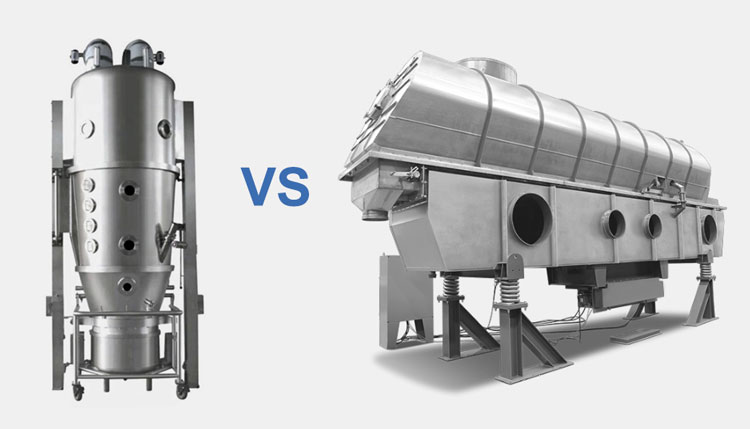
Batch vs continuous fluidized bed processing
This industrial engineering evaluation establishes the definitive mechanical variables and thermodynamic metrics governing batch versus continuous fluidized bed drying, agglomeration, and spray granulation under strict cGMP manufacturing criteria.
1.What is the main difference between batch and continuous fluidized bed processing?
Do you face bottlenecks in your granulation line? Limited machine capacity stops your business growth. I will explain how continuous systems remove these limits completely.
Batch fluidized beds use vertical, cylindrical designs with strict volume limits. Continuous fluidized beds use horizontal, rectangular designs. You feed powder at the front and discharge finished granules at the end. This provides endless capacity and requires only one operator.
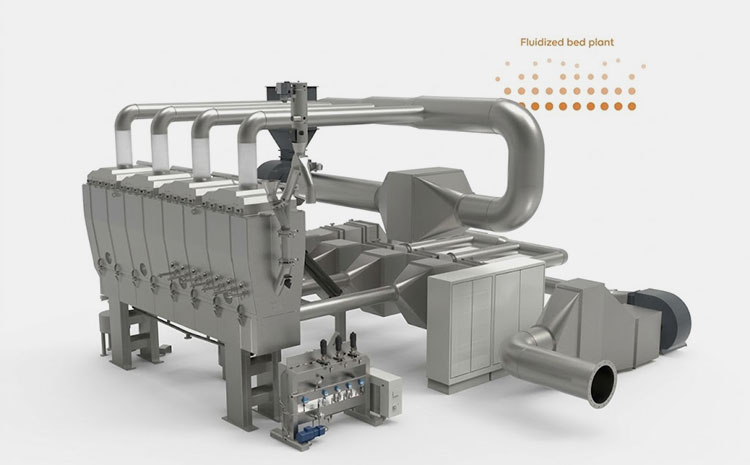
Continuous fluidized bed equipment design
Scaling up solid dosage granulation from pilot development to high-volume industrial output introduces substantial mechanical strain when restricted to legacy batch processing setups.
Standard vertical cylindrical processors operate on a stop-and-go sequence, demanding frequent operational shutdowns for product loading, system stabilization, and manual material discharging.
This mechanical latency generates significant operational downtime, heightened cleanroom contamination exposure, and batch-to-batch chemical variances that limit mass manufacturing scalability.
Structural Differences
Optimizing fluid dynamics requires maintaining a low, controlled material bed height. In a continuous horizontal matrix, this reduced material thickness enables the atomized liquid binder spray to penetrate and coat all circulating seed particles uniformly.
You do not need to stop the machine at all. We design these systems to fit your factory layout perfectly. GMP compliance is very easy to achieve with this design. You save money on labor. You also save space in your facility.
Capacity and Automation
Continuous systems offer almost unlimited capacity. They are perfect for medium to high-volume production. I highly recommend them for making pharmaceutical granules, instant drinks, and baby food.
You can run the entire system automatically. One person can manage the whole process from a control panel.
| Feature | Batch Fluidized Bed | Continuous Fluidized Bed |
| Design Shape | Vertical, cylindrical | Horizontal, rectangular |
| Production Flow | Stop-and-go | Non-stop, steady |
| Capacity Limit | Very limited | Almost unlimited |
| Best For | Small volume, varied recipes | Medium to large volume runs |
| Automation Level | Manual loading/unloading | Fully automatic operation |
When you switch to a continuous process, your factory output increases immediately. We build these systems to handle your largest orders without breaking down.
2.How does fluidized bed technology optimize process efficiency and lower costs?
Are high operational costs eating your profits? Wasted energy and inconsistent quality hurt your bottom line. I will show you how continuous technology cuts costs and improves product stability.
Continuous fluidized beds operate with a lower material bed height. This ensures much better liquid distribution than batch processes.
Better distribution means highly uniform and repeatable product quality. This efficiency lowers energy use and makes the continuous process profitable even for smaller processing volumes.
Many factory managers worry about the high costs of powder processing. High dust loads create serious risks. Dust affects product quality. Dust also creates hygiene and safety hazards in your plant.
Better Liquid Distribution
Optimizing fluid dynamics requires maintaining a low, controlled material bed height. In a continuous horizontal matrix, this reduced material thickness enables the atomized liquid binder spray to penetrate and coat all circulating seed particles uniformly.
A lower layer allows the liquid spray to reach all particles evenly. This uniform distribution is the secret to high-quality granules. You get a stable mixture every single time.
Lowering Operational Costs
When the liquid spreads evenly, you waste less raw material. You also use less heat and energy to dry the product. We install precise temperature controls in our equipment. The hot air dries the material quickly.
The system uses less energy because it runs without stopping. You do not need to heat up a cold machine every few hours. Smooth flow and safe production are the most important factors for your profitability.
| Cost Factor | Batch Processing Impact | Continuous Processing Impact |
| Energy Use | High (frequent stops/starts) | Low (steady state operation) |
| Material Waste | Higher risk of uneven coating | Very low (uniform distribution) |
| Dust Control | Harder to manage safely | Easy to contain and reduce |
| Labor Cost | High (needs loading crew) | Low (one operator needed) |
These optimized process characteristics are very important for powder products. This consistency builds product trust and saves you money in the long run.
3.Why is fluidized bed agglomeration crucial for product solubility and tableting?
Do your instant drinks fail to dissolve quickly? Poor powder structure frustrates your customers. I will explain how agglomeration creates the perfect porous granules for instant dissolution.
Fluidized bed agglomeration sprays liquid onto powder to bind particles together. This process creates loose, highly porous granules.
These porous structures dissolve very quickly in water. They also compress easily, requiring lower pressure to form highly stable pharmaceutical tablets.
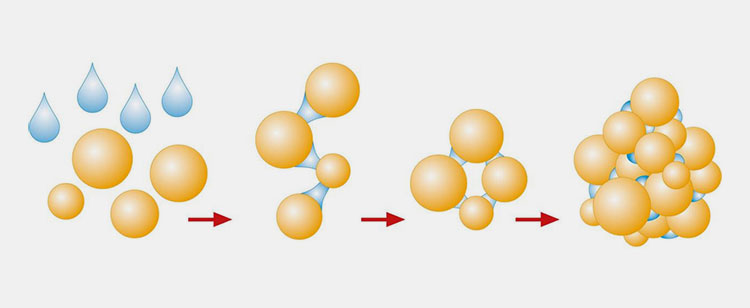
Fluidized bed agglomeration for instant dissolution
Consumers expect high-quality products. They want a great look and perfect application results. If you make instant coffee or soup powder, the powder must dissolve instantly.
The Science of Agglomeration
The fluid bed agglomeration process strategically utilizes localized liquid bridges to transform micro-fine powders into larger, structurally stable macro-clusters. Introducing a controlled atomized liquid binder into the fluidized cloud causes colliding particles to adhere immediately via capillary forces.
Nutraceutical companies use this method for vitamin powders. The fast dissolution helps the body absorb vitamins quickly. We offer complete formulation support to help you find the exact binder liquid.
Benefits for Tableting
This porous structure is also very important for making tablets. When you put these granules into a tablet press machine, they crush and lock together easily. You do not need to use high pressing force. This protects the active ingredients and extends the life of your tablet press tooling.
| Product Type | Why Agglomeration Helps | Resulting Benefit |
| Instant Drinks | Water enters pores quickly | Fast, lump-free dissolving |
| Pharma Tablets | Granules lock under low pressure | High stability, less machine wear |
| Vending Mixes | Dust-free, free-flowing | Accurate dosing in machines |
We design our solid processing solutions to control this particle size perfectly. Proper agglomeration improves handling and guarantees the exact dose for every single serving.
4.What makes spray granulation different from standard agglomeration?
Do you need to turn raw liquids directly into solid granules? Standard drying methods can be messy and inefficient. I will show you how spray granulation solves this challenge perfectly.
Spray granulation builds solid granules directly from liquids, melts, or suspensions. The liquid atomizes in the fluidized bed and coats a seed particle. The liquid evaporates, leaving a solid shell. This creates compact, round, low-dust, and highly durable granules.
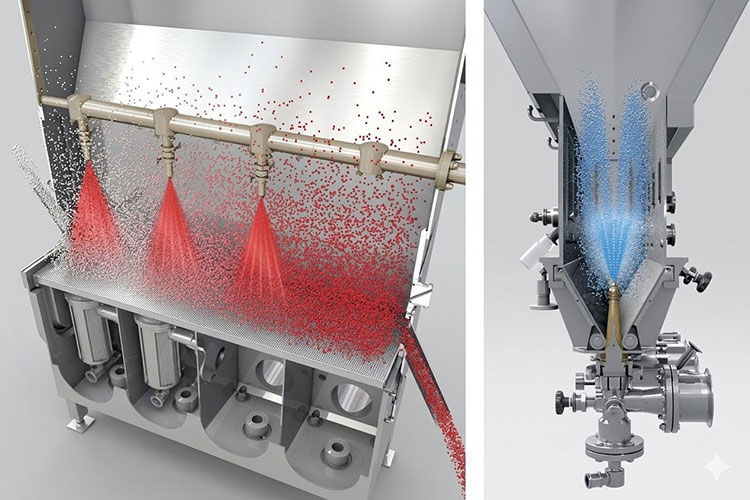
Spray granulation process in fluidized bed
For manufacturing processes initiating from liquid concentrates, suspensions, or melts rather than dry solid inputs, fluidized bed spray granulation executes direct fluid-to-solid phase transitions within a single operational environment.
The Shell-Building Process
In spray granulation, we spray the liquid into the hot air of the fluidized bed machine. The liquid droplets hit tiny solid seeds. The heat evaporates the water immediately. The solid material from the liquid forms a hard shell around the seed.
This process repeats. The granule grows layer by layer, like an onion. We provide complete integrated production engineering for this. We set up the air exhaust systems to keep your cleanroom perfectly safe.
Perfect for Durable Products
Because the layers build up tightly, the final granule is very compact. It is heavy, round, and has almost no dust. It resists breaking during transport. Cosmetic manufacturers use spray granulation for special face powders. The round granules feel very smooth on the skin.
| Feature | Fluidized Bed Agglomeration | Fluidized Bed Spray Granulation |
| Starting Material | Dry powder | Liquid, solution, or melt |
| Granule Structure | Loose and highly porous | Compact, dense, and round |
| Primary Use | Fast dissolving, easy pressing | High durability, slow release |
| Dust Level | Low | Extremely low (almost zero) |
Between agglomeration and spray granulation, we can create many intermediate stages. We can even coat pellets at the same time. This flexibility helps you create the exact product your customers need.
Conclusion
Continuous fluidized bed processing maximizes your production efficiency. It lowers costs, ensures uniform granule quality, and provides scalable solutions for your pharmaceutical and food manufacturing needs.
Batch vs Continuous Fluidized Bed Processing FAQ
References
1.FDA Guidance for Industry: PAT — A Framework for Innovative Pharmaceutical Development, Manufacturing, and Quality Assurance —— U.S. Food and Drug Administration (FDA)
2.cGMP Guidelines for Continuous Manufacturing of Solid Dosage Forms —— International Council for Harmonisation (ICH) Q13 Alignment
3.Fluidization Kinetics and Layer-by-Layer Particle Growth in Continuous Horizontal Granulation Arrays —— Powder Technology Journal
4.Thermodynamic Modeling of Heat and Mass Transfer inside Industrial Fluidized Bed Dryers —— International Journal of Heat and Mass Transfer
Don't Forget To Share Article!

Mason
Senior Pharmaceutical Automation Engineer & Fluidic Systems Specialist at AIPAK
Mason brings over a decade of hands-on technical experience in engineering high-containment fluid delivery loops, industrial water purification infrastructure (WFI), and cGMP-compliant sterile packaging lines for international markets. Specializing in the mechanical design of multi-station washing-filling-sealing production matrices, automated high-voltage leak detection (HVLD), and ATEX-certified component isolation, his validation workflows ensure that volatile and light-sensitive chemical formulations achieve complete regulatory harmony across complex ASEAN and European biopharmaceutics logistics sectors.
Granulator Machine Related Products
Granulator Machine Related Posts




















Granulator Machine Related Videos
CONTACT US
Tell us your raw material and project budget to get quotations within 24 hours.
WhatsApp Us: +86 181 7101 8586

Want the best price & newest pharmaceutical machinery buying guide,tips and trends sent straightly to your box? Sign up for AIPAK’s monthly newsletter, we’re free for your consultation and Offer you the most suitable solutions!
The Buyer's Guide
- Capsule Filling Buyer's Guide
- Blister Packaging Buyer's Guide
- Tablet Counting Buyer's Guide
- Tube Filling Buyer's Guide
- Cartoning Buyer's Guide
- Gummy Making Buyer's Guide
- CO2 Extraction Buyer's Guide
- Empty Capsules Buyer's Guide
- Suppository Filling Buyer's Guide
- Tablet Coating Buyer's Guide
- Tablet Press Buyer's Guide
- Softgel Encapsulation Buyer's Guide
Most Popular
- 7 Importance Of Pharmaceutical Packaging In Different Applications You Must Know
- 6 Advantages You Must Know About Tablet Counting Machine
- 8 Advantages of Blister Packaging You Must Know
- 6 Critical Applications of Automatic Capsule Filling Machine
- 6 Stations You must Know to Improve the Filling Quality of Automatic Capsule Filling Machin