
Lab-Scale Softgel Encapsulation Machine Integration: Complete R&D Production Solutions for Essential Oils
Expanding your product line from essential oils to softgels can feel risky and complicated if you lack manufacturing experience. You might worry about wasting money on the wrong equipment or failing to produce quality capsules. We turn this complex transition into a simple, guided process for you.
We provide a comprehensive R&D production solution that includes the SEM-50 softgel machine, custom facility layout design, and precise formulation support. This helps companies successfully launch new softgel products, ensuring high-quality results from the very first batch while minimizing startup risks.
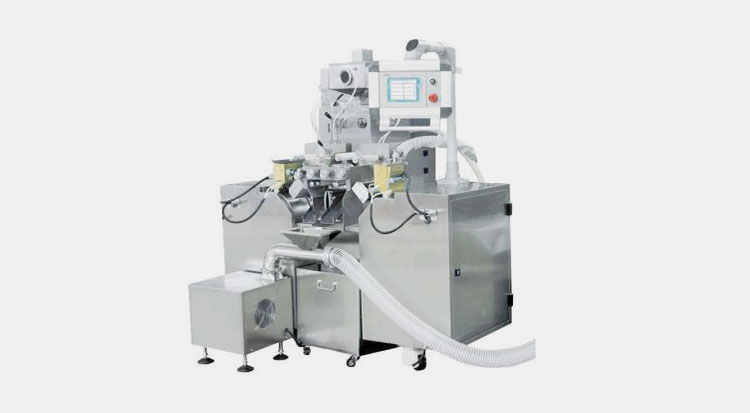
SEM-50 Softgel Machine for R&D
Many manufacturers sell you a machine and walk away, leaving you to figure out the rest. That is not how we work. We stay with you to ensure your production line actually works.
1.How Do We Handle Inquiries from New Softgel Manufacturers?
In 2023, I received an inquiry from a client in California who wanted to make softgels. They were worried about choosing the right machine for a new product launch.
We analyze your background and market needs immediately. For this client, we identified they were a top brand moving from oils to softgels. We recommended the SEM-50 lab scale softgel machine as the perfect entry-level tool for testing the market without a massive initial investment.
Analyzing procurement inquiries from established botanical extraction entities necessitates evaluating market validation metrics alongside existing infrastructure parameters.
For processing facilities specialized in hard capsule formulations and volatile essential oils, expanding oral solid dosage (OSD) portfolios to encapsulate hydrophobic matrices introduces separate chemical and mechanical challenges.
Utilizing a high-precision, low-volume SEM-50 laboratory softgel encapsulation machine serves as an optimal pilot-scale validation strategy, allowing brands to audit multi-phase oil formulations while containing initial capital expenditures.This is a very smart approach for a new product launch.
Based on this, I knew they needed a machine that was precise but not too large. I recommended our SEM-50 Laboratory Softgel Encapsulation Machine. This machine is small, but it works exactly like the big ones. It is perfect for R&D (Research and Development). It allows you to make small batches to test your formula. If the market likes the product, you can scale up later.
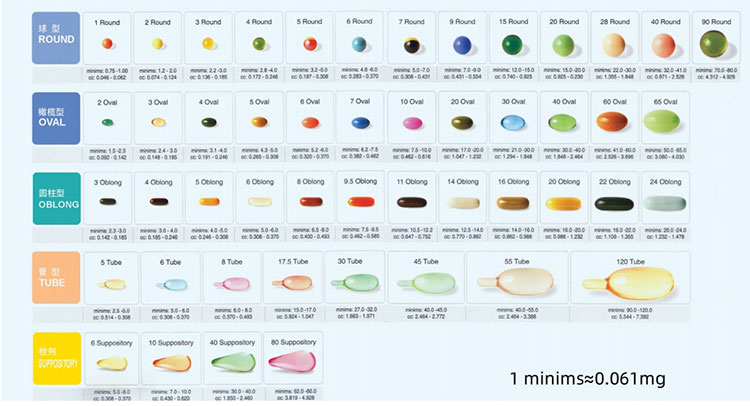
Optional mold shapes from AIPAK
We also discussed molds. The shape of the softgel is very important for branding. I sent them a list of optional mold shapes. We looked at round, oval, and oblong shapes. We helped them choose a standard shape that is popular in the market. This helps them keep costs down for the first run. This step is critical. It saves the client from buying a machine that is too big or too expensive for their current needs.
| Feature | SEM-50 (R&D Model) | Standard Production Model |
| Purpose | Lab testing, small batches, R&D | Mass production, high volume |
| Speed | Lower speed, high precision | High speed, continuous output |
| Cost | Low entry cost | Higher investment |
| Space | Compact design | Requires large facility space |
| Material Usage | Low waste (good for expensive oil) | Higher material consumption |
2.Why Is Factory Layout Planning Crucial for Softgel Production?
The client had a factory, but they did not know how to arrange the equipment for softgel production. Poor layout leads to production failures and wasted materials.
We requested their factory blueprints and created a custom machine layout for them. We also provided strict temperature and humidity requirements. This ensures the environment is perfect for drying and storing softgels, which is the most critical part of the process.
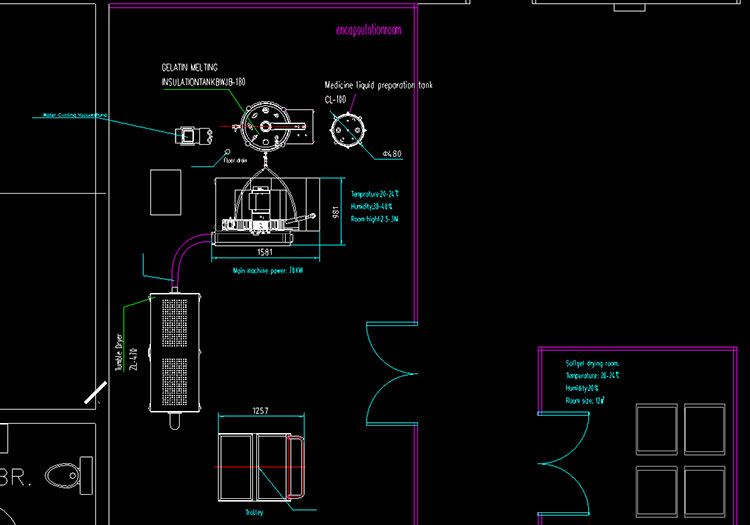
Softgel Factory Layout Design Blueprint
Sustaining structural shell stabilization during lipid encapsulation is heavily governed by surrounding thermodynamic and ambient cleanroom variables. Unlike conventional tableting tracks, softgel ribbon formation relies on precise gelatin cooling and subsequent controlled mass-transfer dehydration.
To prevent immediate capsule localized tackiness and shell collapse, the facility's floor plan must isolate the high-heat gelatin melting phase from the low-humidity encapsulation and tumble drying cells, establishing a continuous cGMP-compliant production workflow.
Remote engineering validation via synchronized video conferencing permits procurement divisions to cross-examine technical hardware tolerances—such as micro-meter ribbon thickness gauge controls and dynamic wedge temperature PID loops—before line fabrication.
Enforcing relative humidity (RH) thresholds strictly within an 18% to 22% baseline window inside the terminal drying tunnel remains a critical validation prerequisite to balance moisture desorption kinetics and achieve unassailable shell hardness.
| Parameter | Recommended Range | Why It Matters? |
| Room Temperature | 20°C - 24°C | Prevents gelatin from melting or becoming too brittle |
| Relative Humidity | 18% - 22% | Ensures the softgel shell dries hard and does not get sticky |
| Air Cleanliness | ISO Class 7 or 8 (GMP) | Prevents contamination of the pharmaceutical product |
| Airflow | Laminar flow | Keeps dust away from the open gelatin ribbon |
3.What Steps Ensure the Machine Is Ready for Production?
You cannot afford for a machine to arrive and not work. This causes delays and hurts your launch schedule. We test everything before it leaves our factory.
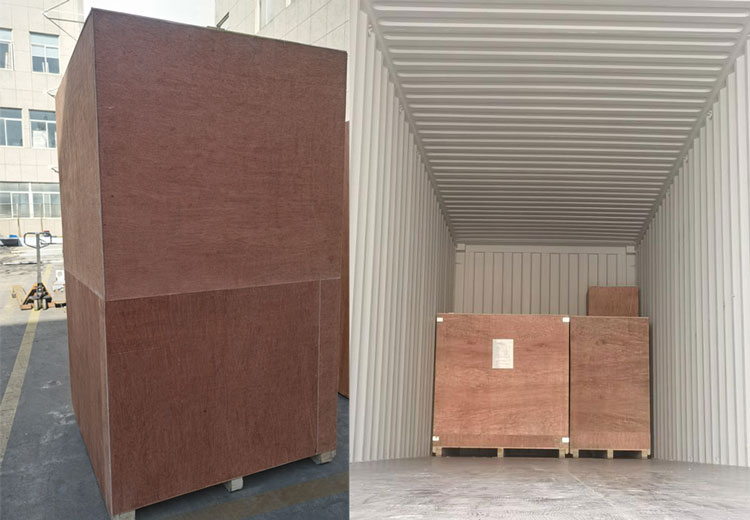
SEM-50 softgel machine shipping
We performed a full performance test on the machine before shipping. We recorded a video of the test and sent it to the client for confirmation. We only shipped the machine after they said "yes." We also included detailed wiring diagrams to make installation easy.
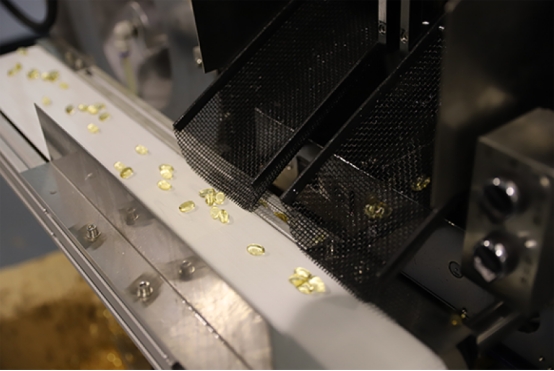
Testing SEM-50 Before Shipment
Pre-shipment performance qualification (PQ) protocols require subjecting the laboratory-scale hardware to continuous operational stressors under variable load conditions. Technicians calibrate the high-precision positive-displacement injection pumps utilizing high-viscosity placebo matrices designed to duplicate the dynamic rheology and fluidics of premium suspensions.
High-frequency video documentation verifies uniform gelatin ribbon casting across the cryogenic drums, absolute symmetry along the rotary die sealing seams, and exact volumetric dosing stability before final cleanroom crating.

Documentation before shipping
We also prepared the documentation. A machine is useless if you do not know how to hook it up. We printed out the user manual in English. We also printed the pneumatic (air) and electrical diagrams. We put these documents in the box with the machine. We also sent digital copies by email. This way, their local electrician could prepare the factory before the machine even arrived. This preparation minimizes downtime. It ensures that when the crate arrives, they can plug it in and start working.
4.How Can Custom Formulations Solve Production Quality Issues?
Even with a good machine, you might face issues with materials. The client complained that their gelatin ribbon was not transparent enough, which affected the product's look.
We did not blame the operator. Instead, we analyzed their material and created a new custom gelatin formula for them. This adjusted the ratio of gelatin, water, and glycerin. With this new recipe, they produced crystal-clear capsules.
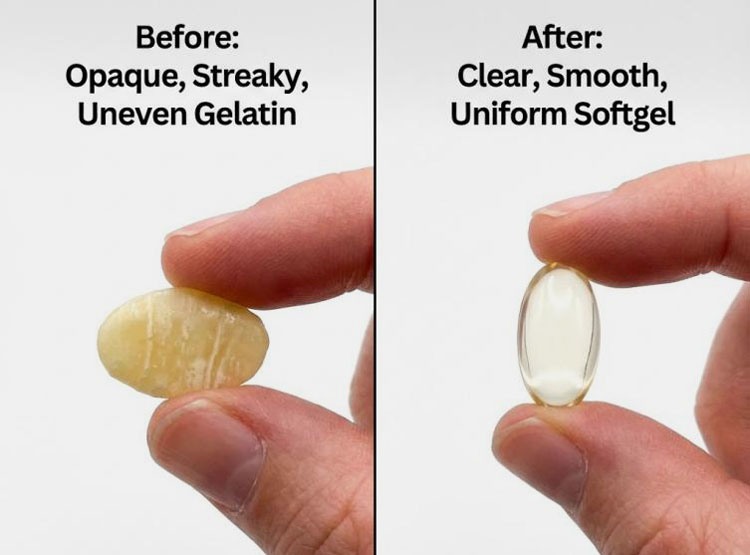
Clear vs Cloudy Softgel Comparison
Following cleanroom commissioning, structural shell opacity or superficial streaking defects can materialize if raw gelatin macromolecular hydration parameters clash with localized ambient variables.
High shell transparency is an essential market validation metric for premium lipid products, as visual blemishes often provoke false assumptions regarding active compound purity. This cosmetic non-conformance is standardly driven by uncalibrated water-to-plasticizer weight ratios or microscopic micro-air entrapment rather than hardware structural failure.
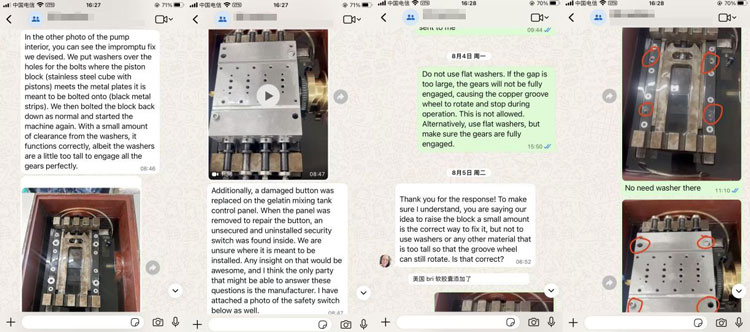
Customer issues after receiving the machine
Corrective action protocols required auditing the formulation mass balance, specifically inspecting the bloom strength and dynamic hot-melt viscosity variables of the gel mass. Chemical engineers micro-adjusted the vacuum degasification dwell times inside the melting vessel to completely eliminate internal microscopic air bubbles that scatter light.
Modifying the relative glycerin-to-dry-gelatin weight ratios alongside fine-tuning the continuous cooking temperature boundaries restored optimal cross-linking kinetics, yielding crystal-clear, high-gloss capsule shell structures.
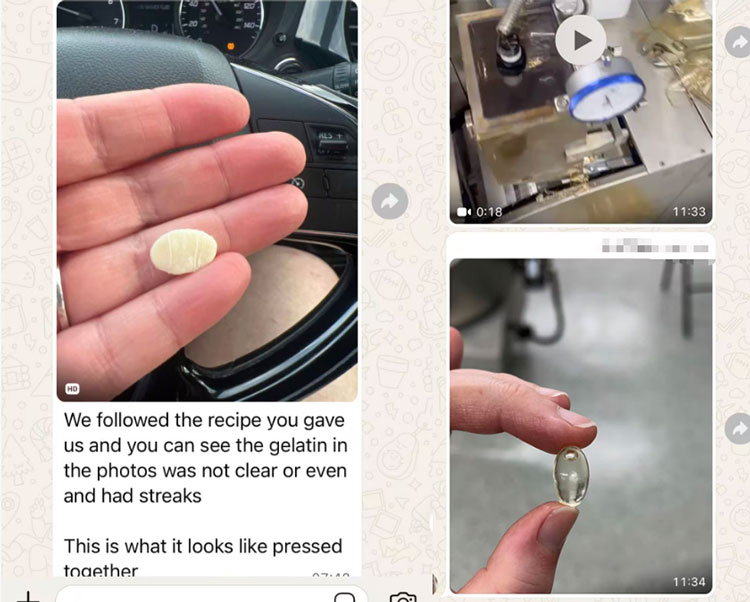
The capsules came out clear and shiny. The client was relieved. This proves that we solve problems. We do not just sell iron and steel; we sell the knowledge to make a final product. This is the difference between a vendor and a partner.
| Problem | Potential Cause | Our Solution |
| Cloudy Shell | Air bubbles or wrong water/glycerin ratio | Adjusted vacuum time and formula ratio |
| Leaking Seam | Temperature too low on wedge | Adjusted PID temperature settings |
| Sticky Capsules | Humidity too high in drying room | Advised on dehumidifier settings |
| Shape Distortion | Drying too fast | Adjusted drying basket speed and air flow |
5.When Should You Upgrade from R&D to Mass Production?
Starting small allows you to learn the process and build a customer base. Once your product is successful, you need to increase capacity to meet demand.
The client was so satisfied with our service and the machine's performance that they are now planning for the future. They told us they will expand their capacity in 2026. They plan to order a larger production line from us to handle volume orders.
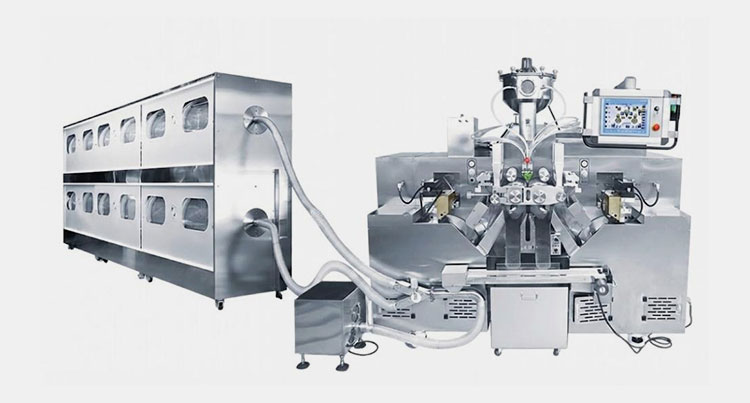
Large Scale Softgel Production Line
Utilizing low-volume pilot platforms allows manufacturing facilities to establish precise baseline standard operating procedures (SOPs) and validate critical process parameters (CPPs) with minimal raw material waste.
Validating the hot-melt parameters and volumetric scaling factors on a high-precision lab system mitigates long-term commercial risks. Once product stability metrics achieve regulatory compliance, the established engineering parameters can be directly transferred onto high-velocity commercial encapsulation lines to scale throughput seamlessly.
They are not looking for other suppliers. They told me directly, "In 2026, we are coming back for the big machine."
This is our goal at AIPAK. We want to grow with you. We treat a small order with the same seriousness as a big order. We know that the small client today is the big client tomorrow. We provide the full lifecycle of support. From the first drawing on a piece of paper to the mass production factory floor, we are there. We are ready to help them scale up when the time comes.
6.How to scale softgel production from R&D to commercial manufacturing?
The key is starting with a versatile R&D softgel encapsulation machine (like the SEM-50 pilot models). These machines allow you to test specific formulations—such as essential oils—using minimal raw materials. Once the process parameters (temperature, ribbon thickness, and filling volume) are validated, they can be directly transferred to larger production lines without re-developing the process, ensuring a smooth transition from lab to factory.
7.What are the challenges of encapsulating essential oils in softgels?
High-value oils and essential oils require high-precision filling pumps to ensure dosage accuracy and minimize waste. Additionally, these oils can sometimes react with standard gelatin. A complete solution often involves testing different shell materials (such as Tapioca or Carrageenan for Vegan options) and using equipment designed to handle volatile or viscous liquids without leakage during the sealing process.
8.What equipment is included in a complete softgel R&D pilot line?
A complete R&D solution typically includes a compact softgel encapsulation machine, a gelatin melting tank (small capacity for lab use), rapid tumble dryers, and a cooling system. For specialized products like softgels, additional integration for oil preparation and visual inspection systems may be recommended to ensure every capsule meets quality standards before mass production.
9.Can your R&D machines handle Vegan (Starch/Alginate) softgel production?
Yes, modern R&D softgel machines are designed with flexibility in mind. They can handle specific temperature controls and die roll designs required for plant-based gelatin alternatives. This is crucial for essential oil markets, where consumers frequently prefer clean-label, vegetarian-friendly capsule shells.
Conclusion
We support you from the first inquiry to full-scale production, offering machines, layouts, and technical solutions to ensure your business grows successfully.
Frequently Asked Questions - Lab Scale Softgel Systems
Project Compliance and Equipment Engineering Standards
During the chemical formula auditing, custom 2D cleanroom space blueprinting, and remote performance qualification (PQ) pre-shipment testing phases of this automated laboratory-scale softgel encapsulation line, all component sub-assemblies were verified to comply with the following international regulations:
Don't Forget To Share Article!
Avril
Senior Pharmaceutical Equipment Specialist & Project Consultant at AIPAK
Avril brings deep, multi-year expertise to the pharmaceutical machinery sector, specializing in solid dosage production lines and complex cleanroom layout engineering. As a veteran project consultant at AIPAK, she is known for her hands-on capability to match technical machine parameters with strict global compliance standards. Passionate about driving real business results, Avril works closely with international pharma clients to solve structural bottlenecks—such as facility footprint constraints and material flow optimization—ensuring they receive tailored, highly efficient one-stop turnkey solutions for their production goals.
Softgel Encapsulation Machine Related Posts











Softgel Encapsulation Machine Related Products
Softgel Encapsulation Machine Related Videos
CONTACT US
Tell us your raw material and project budget to get quotations within 24 hours.
WhatsApp Us: +86 181 7101 8586

Want the best price & newest pharmaceutical machinery buying guide,tips and trends sent straightly to your box?Sign up for Aipak’s monthly newsletter,we’re free for your consultation and Offer you the most suitable solutions!
The Buyer's Guide
- Capsule Filling Buyer's Guide
- Blister Packaging Buyer's Guide
- Tablet Counting Buyer's Guide
- Tube Filling Buyer's Guide
- Cartoning Buyer's Guide
- Gummy Making Buyer's Guide
- CO2 Extraction Buyer's Guide
- Empty Capsules Buyer's Guide
- Suppository Filling Buyer's Guide
- Tablet Coating Buyer's Guide
- Tablet Press Buyer's Guide
- Softgel Encapsulation Buyer's Guide
Most Popular
- 7 Importance Of Pharmaceutical Packaging In Different Applications You Must Know
- 6 Advantages You Must Know About Tablet Counting Machine
- 8 Advantages of Blister Packaging You Must Know
- 6 Critical Applications of Automatic Capsule Filling Machine
- 6 Stations You must Know to Improve the Filling Quality of Automatic Capsule Filling Machine