
Parenteral Monoblock Engineering: Custom Rotary Filling and Capping Solutions for Multi-Format 5ml to 100ml Vials
Integrating divergent container form-factors—specifically micro-dose 5ml ophthalmic vials and high-volume 100ml diagnostic reagent bottles—onto a single processing train presents severe mechanical containment barriers due to conflicting closure mechanisms and volumetric scale disparities.
To eliminate high cleanroom floor-space overhead and mitigate line jamming under rapid format changeovers, modern automated lines must transition from standard linear fill arrays to synchronized rotary monoblock architectures.
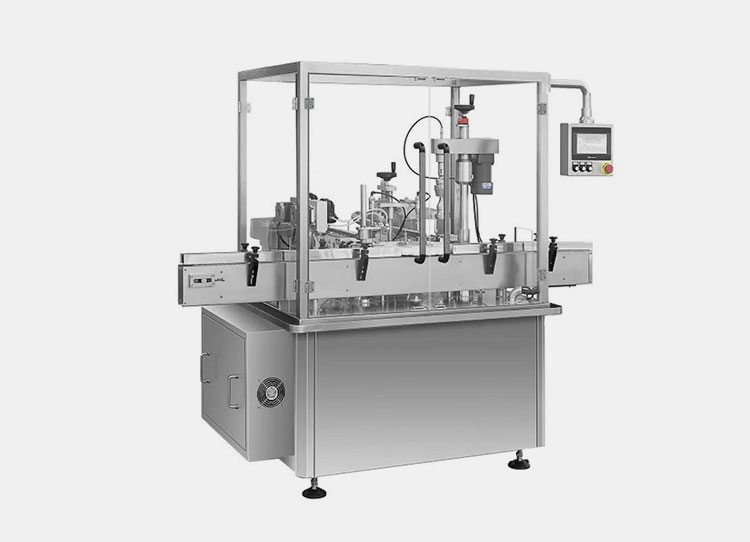
Versatile Eye Drop Filling Machine
This technical case study chronicles the custom engineering configurations executed for a pharmaceutical production facility in Egypt, illustrating how automated pneumatic lifting arrays and synchronized servo-driven piston pumps achieve complete OEE stabilization under tight cleanroom spatial envelopes.
1.Why Do Suppliers Say You Cannot Mix Small Vials and Large Bottles?
Do bottle jams ruin your production run? Most standard machines fail when bottle sizes change too much. This causes downtime, lost money, and endless frustration for your operators.
Most suppliers avoid mixing extreme bottle sizes because it requires frequent mold changes and high operator skill. Linear machines often jam when handling both tiny 5ml vials with inner plugs and large 100ml bottles with only outer caps.
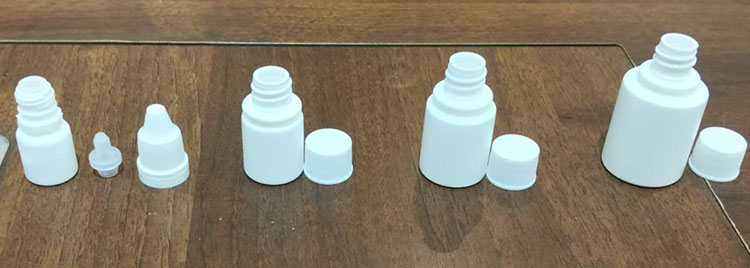
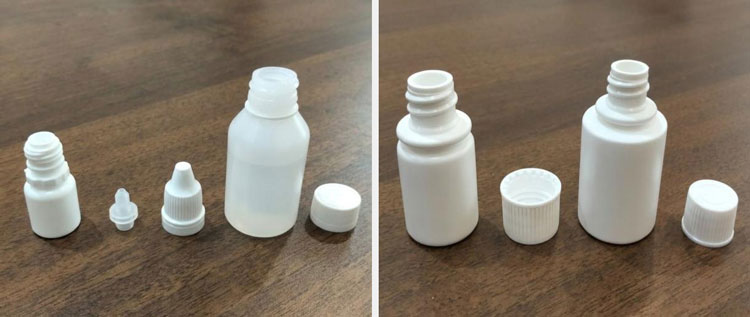
Pharmaceutical bottle size comparison
When you talk to most equipment suppliers, they will tell you to buy two separate machines. I hear this all the time. The reason is simple. A 5ml eye drop bottle is tiny. It needs an inner plug and an outer cap.A 100ml diagnostic reagent bottle is much larger. It only needs an outer cap.
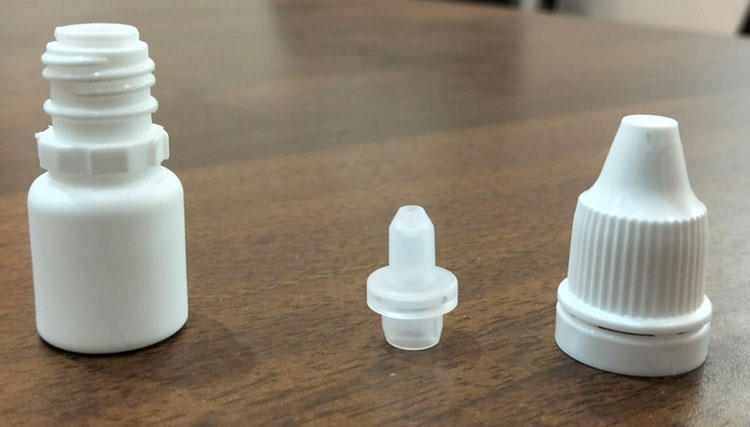
5ml eye drop bottle with inner plug and outer cap
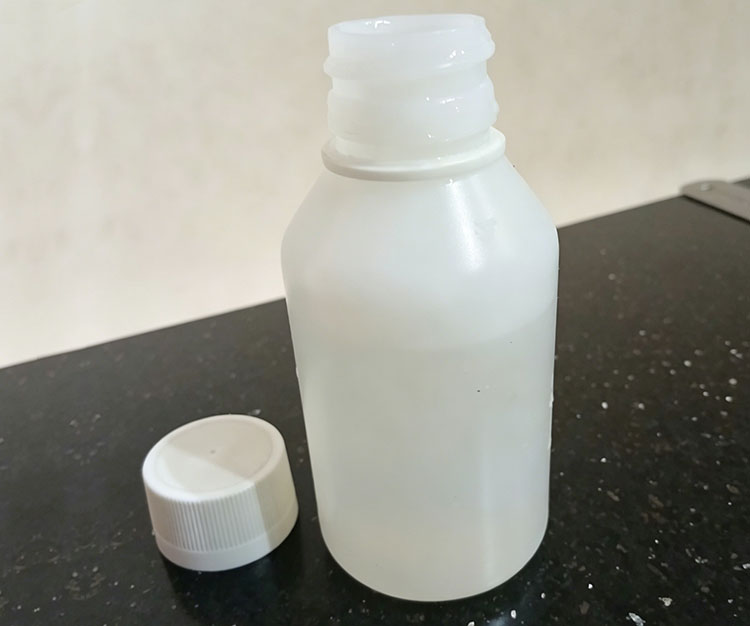
100ml bottle with only outer cap
Standard liquid packaging configurations demonstrate severe physical constraints when migrating between extreme dimensional thresholds on a single operational platform.
Conventional linear filling arrays frequently incur severe structural jamming when transitioning from a 5ml eye drop container—which requires sequential primary tip inserting and secondary outer cap torque threading—to an open-aperture 100ml reagent form-factor that bypasses internal plugging entirely.
While legacy equipment suppliers mitigate this kinematic variability by mandating separate equipment trains, AIPAK bypasses extensive capital expenditures through custom rotary star-wheel integration, enabling extreme format flexibility without introducing cross-contamination risks or operator parameter errors.
We like to look deeper into the problem. We know that forcing different bottles into a basic machine causes trouble. But with the right custom design, we can avoid these jams completely.
| Feature | Standard Linear Machine | Custom Monoblock Machine |
| Bottle Range | Narrow (similar sizes only) | Wide (5ml to 100ml) |
| Jam Risk | High for mixed sizes | Very low |
| Operator Skill | High (frequent adjustments) | Low (touch screen control) |
| Mold Changes | Slow and hard | Fast and easy |
2.How Does One Cleanroom Fit Multiple Filling Demands?
Is your cleanroom too small for multiple production lines? Expanding your factory costs too much money and time. You need a way to do more in a small space.
A client from Egypt faced limited cleanroom space for a new product line. Buying two separate eye drop filling machines meant high initial investment and double the labor costs. A single, versatile machine was the only way to fit their budget and space limits.
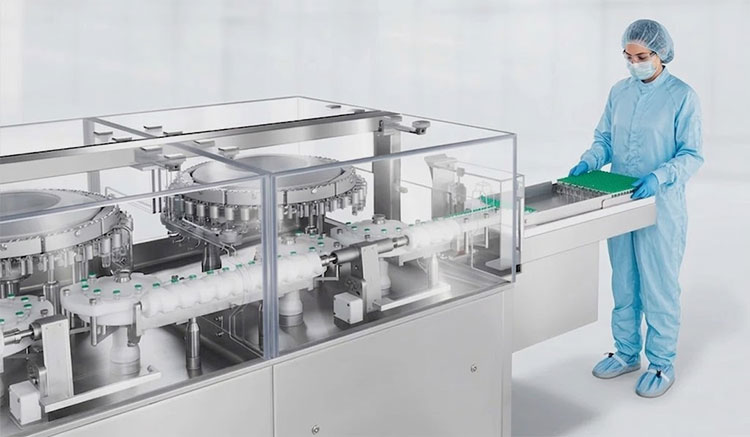
Cleanroom pharmaceutical packaging machine
A project evaluation for an Egyptian pharmaceutical production facility identified severe layout constraints within their newly certified cleanroom envelope, precluding the installation of multiple dedicated packaging lines.
The operational directive required processing four distinct container geometries ranging from 5ml to 100ml fluidic volumes on a singular, high-velocity axis. By executing custom design modeling and verifying past process validation videos of synchronized indexing blocks, AIPAK bypassed traditional mechanical friction limits, engineering a high-density rotary configuration that aligns with restricted factory footprints and tight operational capital parameters.
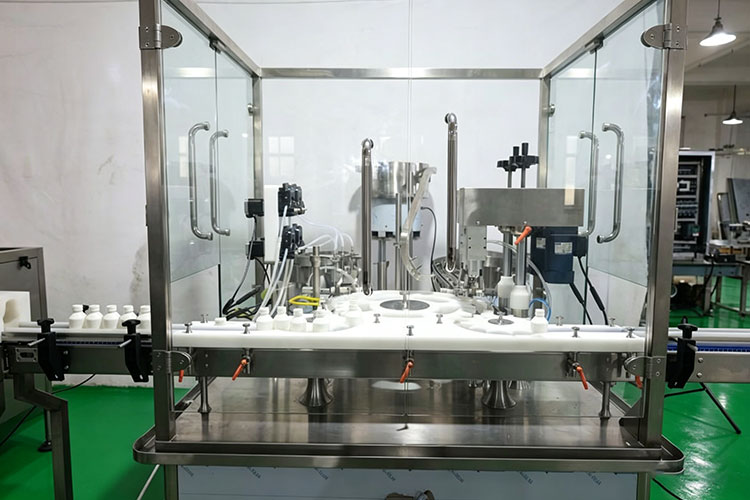
I promised him our technical team would provide a custom plan. By understanding his space and budget limits, we knew we had to design something special. We could not just give him a standard eye drop filling machine.
| Cost Factor | Two Separate Machines | One Custom Machine |
| Machine Cost | Double investment | Single investment |
| Cleanroom Space | Needs large floor area | Fits in tight spaces |
| Labor Cost | Needs two full teams | Needs one small team |
| Maintenance | High upkeep | Lower upkeep |
3.What Makes the Rotary Monoblock Machine the Best Solution?
Are linear filling lines causing you trouble with different caps? Dropped caps and slow speeds kill your daily output. You need a smarter, more stable way to pack.
We used a rotary filling, plugging, and capping monoblock machine instead of a linear one. For eye drops, a robot arm places the inner plug. For larger bottles, a touch screen command lifts the plugging station so bottles pass directly to capping.
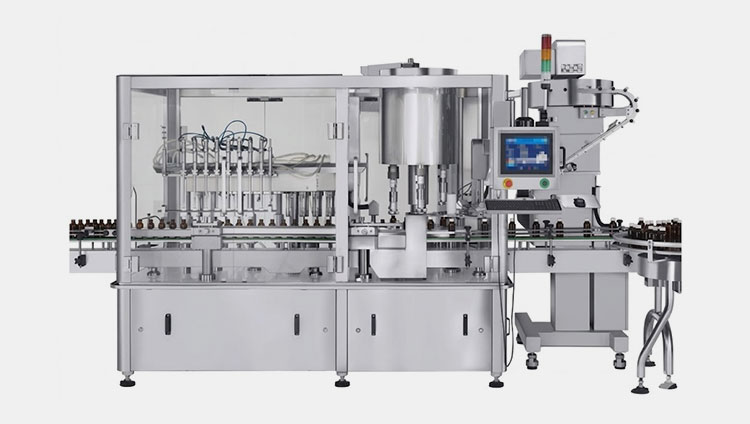
Rotary monoblock filling capping machine
After we held a video meeting with the client, I explained exactly how we would solve his problem. We quoted him a rotary monoblock machine. This is an all-in-one filling, plugging, and capping unit.
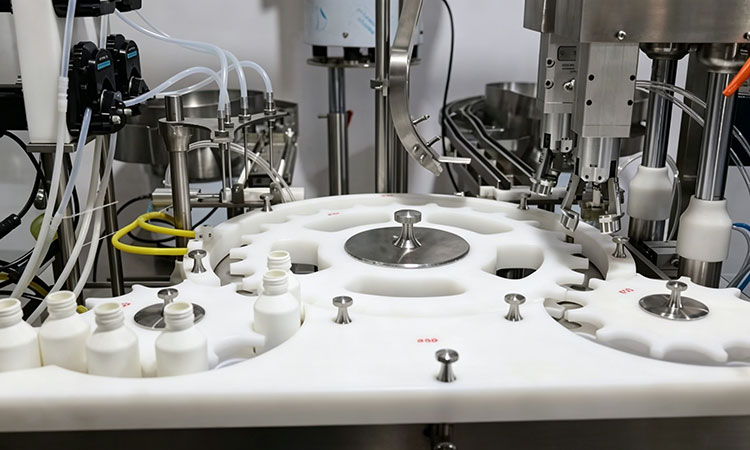
We did not use a linear separated machine. Rotary machines are much better for handling different bottles smoothly without jamming. The most clever part of our design is the inner plug station.
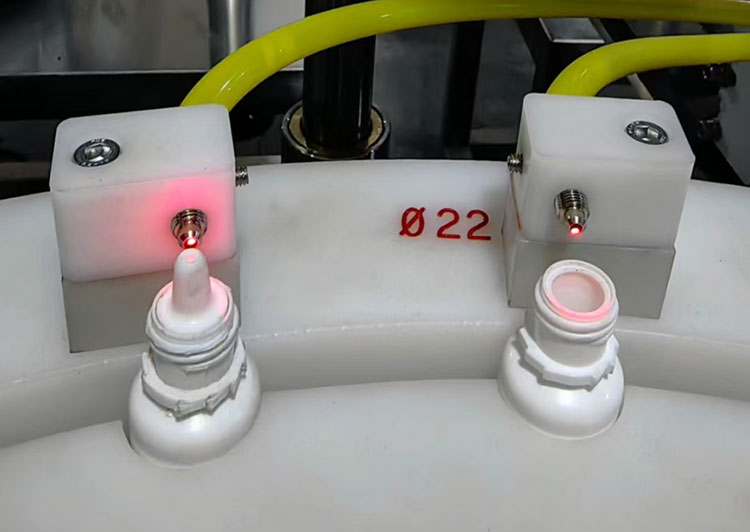
Inner plug station
When the machine runs the 5ml eye drops, a mechanical arm picks up and places the inner plug normally. But what happens when you switch to the 100ml reagent bottle that has no inner plug?
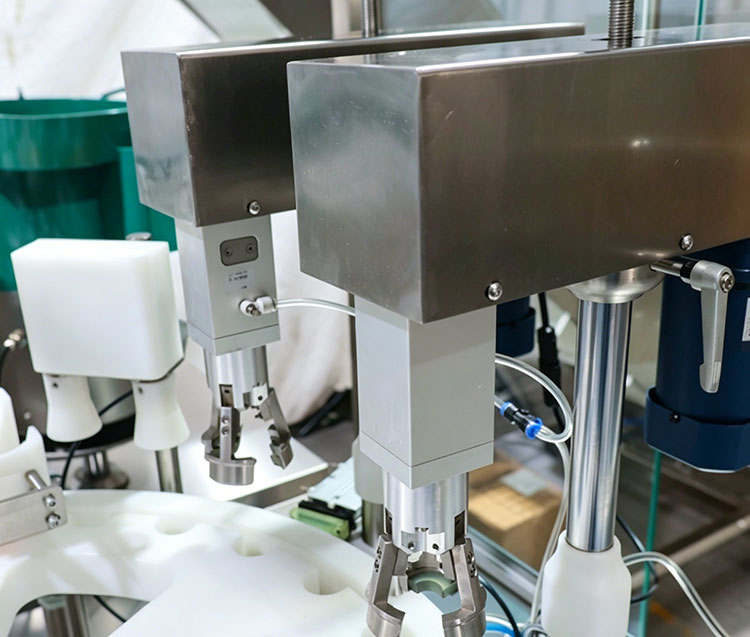
You simply press one button on the touch screen. The entire plugging mechanism automatically pauses and lifts up. The large bottles just pass right under it. They go straight into the final capping stage.
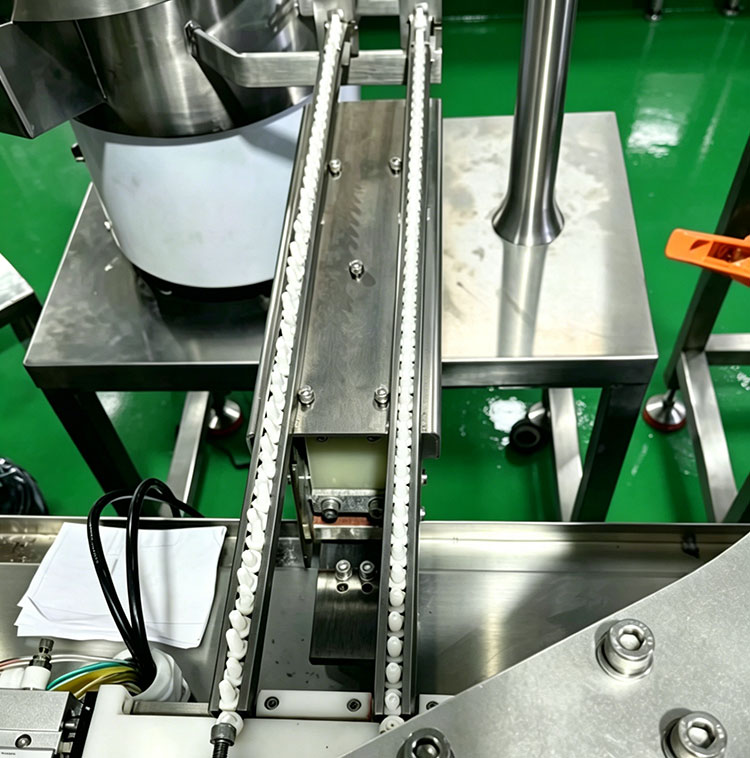
Extra cap vibrator bowl
It is that simple. You do not need tools to remove the plugging station. Because the cap sizes were also very different, we added an extra cap vibrator bowl. This custom design means the operator does very little physical work. The machine's brain does the heavy lifting.
| Machine Part | Action for 5ml Eye Drops | Action for 100ml Reagents |
| Main Structure | Rotary smooth movement | Rotary smooth movement |
| Inner Plugger | Robot arm inserts plug | Lifts up, pauses via screen |
| Outer Capper | Uses small cap vibrator | Uses extra large cap vibrator |
| Changeover | Fast mold swap | Fast mold swap |
4.How Do We Ensure High Speed and Precision for Different Volumes?
Is your machine too slow when filling large bottles? Poor filling accuracy wastes your expensive liquid product. You need a system that is fast and exact every time.
We used a 4-head servo piston pump to ensure high speed and precision. The machine fills four bottles at once, easily reaching 60 bottles per minute for 100ml. For volumes under 30ml, we provided extra filling needles to keep the accuracy perfect.
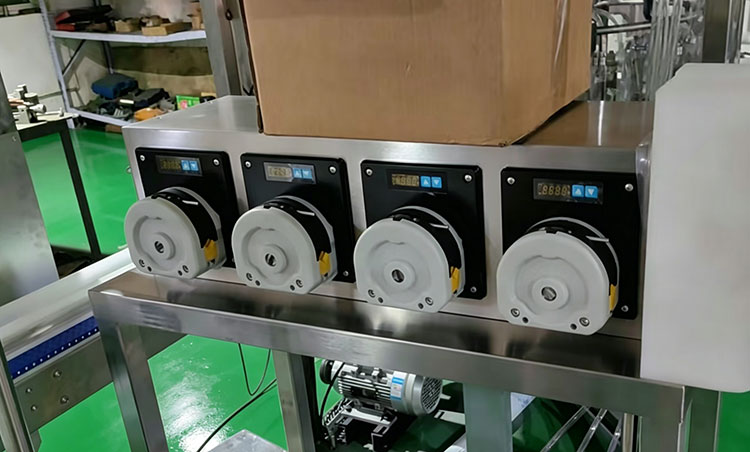
head servo piston pump
The client had a strict speed rule. The machine had to reach 50 to 60 bottles per minute, even at the maximum 100ml volume. A standard single-head filler would be far too slow for this.
To meet this need, we installed a 4-head servo piston pump. This means four nozzles dispense liquid at the same exact time. This easily hits the 60 bottles per minute target for the big 100ml bottles.
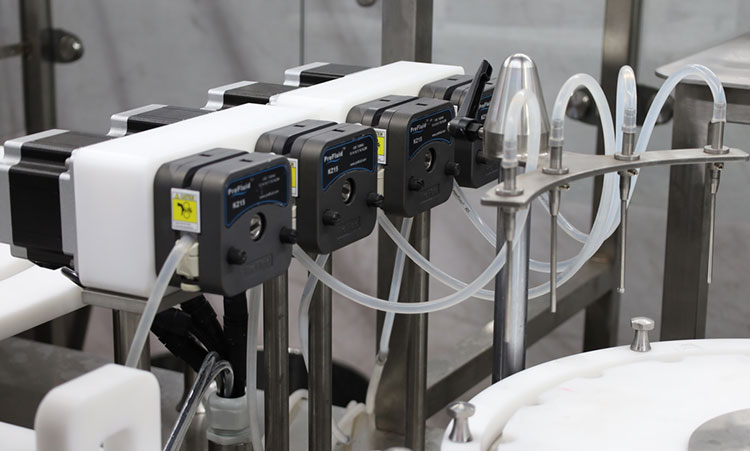
Pumps controlled by servo motors
Servo motors control the pumps. This gives very high accuracy. You will not waste your expensive liquid products. However, filling 5ml and filling 100ml require different tools to stay accurate.
Operating large-diameter filling orifices inside micro-dose 5ml neck apertures induces severe fluidic turbulence and product spillage under continuous velocity.
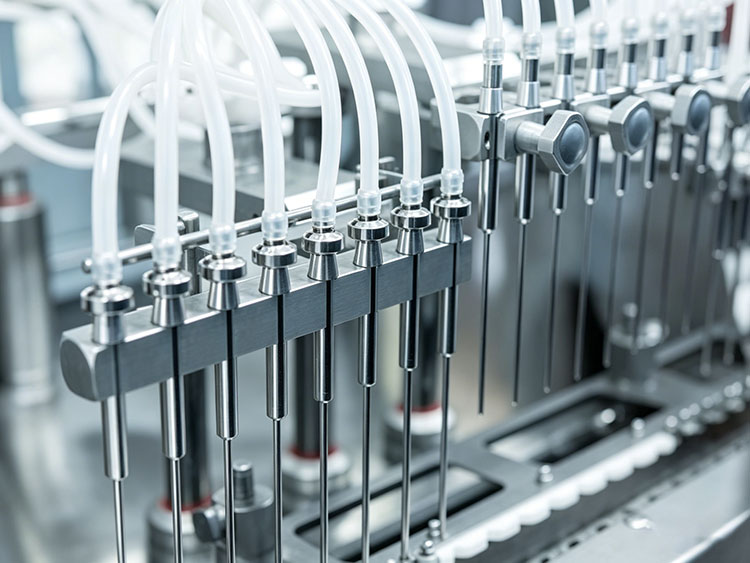
Extra filling needles
To enforce zero-splash precision across the entire production matrix, the 4-head servo piston configuration integrates interchangeable positive-displacement diving needle arrays specifically calibrated for volumes below 30ml.
Operators complete toolless nozzle changeovers during standard batch transitions, ensuring high-accuracy volumetric leveling and absolute moisture protection across all target containers.The operator just swaps the needles when changing bottle sizes.
This setup guarantees that every bottle gets the exact right amount of liquid. The client was very happy to see that one machine could handle all his needs perfectly.
| Filling Volume | Pump Type | Nozzle Setup | Target Speed |
| 5ml | 4-head servo piston | Small extra needles | 60 bottles/min |
| 30ml | 4-head servo piston | Small extra needles | 60 bottles/min |
| 100ml | 4-head servo piston | Standard large nozzles | 50-60 bottles/min |
| Accuracy | High precision servo | Zero splash | Steady output |
Conclusion
A custom rotary monoblock machine easily runs both 5ml vials and 100ml bottles. It saves space, lowers costs, and gives you fast, precise filling for all your products. Struggling with diverse bottle sizes and limited cleanroom space? Don't let standard equipment hold back your production. Click here to consult AIPAK’s engineering team for a Free Eye Drop Filling Machine Compatibility Audit and a customized 3D layout today!
References
1.FDA Guidance for Industry: Sterile Drug Products Produced by Aseptic Processing — GMP Controls —— U.S. Food and Drug Administration (FDA)
2.ISO 14644-4 Cleanrooms and Associated Controlled Environments: Design, Construction, and Start-up —— International Organization for Standardization
3.Kinematic Modeling and Volumetric Precision of Servo-Driven Monoblock Rotary Filling Arrays for Micro-Dose Parenterals —— Journal of Pharmaceutical Engineering
4.Torque Synchronization and Mechanical Alignment of Automated Capping Chucks in Multi-Format Pharmaceutical Packaging Lines —— Advanced Machinery & Automation Review
Don't Forget To Share Article!

Mason
Senior Pharmaceutical Automation Engineer & Fluidic Systems Specialist at AIPAK
Mason brings over a decade of hands-on technical experience in engineering high-containment fluid delivery loops, industrial water purification infrastructure (WFI), and cGMP-compliant sterile packaging lines for international markets. Specializing in the mechanical design of multi-station washing-filling-sealing production matrices, automated high-voltage leak detection (HVLD), and ATEX-certified component isolation, his validation workflows ensure that volatile and light-sensitive chemical formulations achieve complete regulatory harmony across complex ASEAN and European biopharmaceutics logistics sectors.
Eye Drop Filling Machine Related Posts








Eye Drop Filling Machine Related Products
Eye Drop Filling Machine Related Videos
CONTACT US
Tell us your raw material and project budget to get quotations within 24 hours.
WhatsApp Us: +86 181 7101 8586

Want the best price & newest pharmaceutical machinery buying guide,tips and trends sent straightly to your box?Sign up for Aipak’s monthly newsletter,we’re free for your consultation and Offer you the most suitable solutions!
The Buyer's Guide
- Capsule Filling Buyer's Guide
- Blister Packaging Buyer's Guide
- Tablet Counting Buyer's Guide
- Tube Filling Buyer's Guide
- Cartoning Buyer's Guide
- Gummy Making Buyer's Guide
- CO2 Extraction Buyer's Guide
- Empty Capsules Buyer's Guide
- Suppository Filling Buyer's Guide
- Tablet Coating Buyer's Guide
- Tablet Press Buyer's Guide
- Softgel Encapsulation Buyer's Guide
Most Popular
- 7 Importance Of Pharmaceutical Packaging In Different Applications You Must Know
- 6 Advantages You Must Know About Tablet Counting Machine
- 8 Advantages of Blister Packaging You Must Know
- 6 Critical Applications of Automatic Capsule Filling Machine
- 6 Stations You must Know to Improve the Filling Quality of Automatic Capsule Filling Machine
Tell us your material or budget,we'll reply you ASAP within 24 hours